

Against Word Count
Why I'll never do the #1000wordsofsummer challenge again

Tomorrow marks the start of the annual #1000wordsofsummer challenge, where tens of thousands of writers around the world commit to writing 1,000 words a day for 14 days. This is the 8th year of #1000wordsofsummer, which was started by author Jami Attenberg as a little hashtag on Twitter that a few hundred people engaged with to a very big thing. I love the energy of it, the inspiring newsletter that goes out each day of the challenge, and also, I’ll never do it again.
Before I go on, let me be clear about this: I LOVE Jami Attenberg. I read The Middlesteins (“a sharp-tongued, sweet-natured masterpiece of Jewish life”) while I was writing my first novel and it slapped me across the face in the best way. I have since devoured the rest of her books, which are full of humor and humanity. Although I don’t know her personally, it is easy to glean from her actions and internet presence that she is a bighearted person: she has used her success to elevate other writers, donate to good causes, and encourage people to get their words down and into the world. Oh and she put together an excellent craft book that will make you cry.
Which is why it breaks my heart that I am not a #1000wordsofsummer person.
*
Writers love assignments. At heart, most of us are good kids. We read the directions. We do our homework. We follow the rules.
I wanted to love #1000wordsofsummer. I wanted to write at least 1,000 words every day and marvel at the end of 2 weeks at the 20,000+ words I had. I wanted to get an A+.
Thing is, I met the brief. I had no trouble writing 1,000 words a day. Most days it took me less than 30 minutes. Quantity is not my problem.
My problem is quality. Every day, after I’d written 1,000 words, I had 999 words I needed to delete. But instead of revising, I plowed on the next day, writing another 1,000 words of hot garbage.
I’ve got nothing against hot garbage—it’s how everything I’ve EVER written has started—but the way it piled up was too much for me. At the end of two weeks, I had so much hot mess on my hands each glance and scroll made me break out in a cold sweat.
I set it aside and never looked at it again. Reluctantly I accepted that I am not a Word Count Warrior.
*
Thankfully, I’ve found an assignment that does work for me: the timer. These days, I set mine for 90 minutes1 and work on my novel until it goes off.
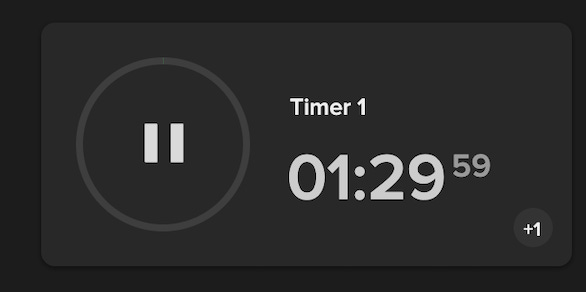
It’s going a helluva lot better than #1000words did—I’ve actually been doing this consistently since January. Initially, 90 minutes felt a lot longer than the 45- and 60-minute sessions I was doing. Sometimes I dreaded sitting down to what felt like an interminable stretch.
But as I said recently to the students in my Friday writing group, I don’t ever ask myself if I want to write. I just do it.
Linda responded, “Like exercise. I never want to exercise, but I’m always glad I did.”
Exactly. And like exercise, it’s a muscle that gets stronger each time you use it. My writing sessions aren’t always easy or fun, but my body has adapted. 90 minutes in the chair feels doable, automatic even.
I just do it. Because I’m Team Timer.
*
The timer is perfect for my present work—I’m revising, which I do in a very nonlinear fashion. For me, revising is a blanket term that includes any/all of the following approaches:
Rereading
Rewriting sentences to make them clearer / sharper
Condensing / compacting (more on this in my post on the revision machete)
Deleting redundancies / inaccuracies (more on overwriting in this post)
Drafting (especially description, gesture, and setting, which I often omit in early drafts; more on that in this post)
Reordering paragraphs and sentences for logical flow
Polishing transitions
Freewriting about the scene’s purpose and turn/character motivation and change
Writing out act summaries in bullet points2
Other3
Most writing sessions include at least three of these. A timer lets me, well, lose track of time. I don’t plan what I’m going to do—I simply follow my creative intuition wherever it wants to take me (which I discuss on the podcast). Some days I get so lost in my head that the timer is an absolute surprise, jarring me out of a flow state I hadn’t noticed myself slip into.4
*
Word counts and timers may be opposing approaches but they have one thing in common: they are constraints, aka limitations and boundaries that give our brain bumpers, allowing it to relax and get going.
Ultimately, it doesn’t matter which constraint you favor. If you’re a Word Count Warrior, great—I hope you have a great #1000words and beyond.
And if you’re flailing a little and are intrigued by Team Timer, give it a shot. Decide how many minutes a day you can commit to and then put it on your calendar for the next two weeks. See how it feels to measure your progress as a writer by the hours spent at your craft.
No matter how you motivate yourself, I’ll be here cheering you on. Keep writing, friend.
J.
I do this every weekday—I have a different strategy for weekends you’ll hear about soon. And if you’re thinking that 90 minutes sounds like a long time, well, it is. If you don’t have that kind of time, shoot for an hour.
The closest I get to outlining
Staring out the window, muttering swear words, wondering how hard it is to fake my own death so I don’t have to finish the book or tell anyone I gave up
#writingisjoy
Thank you for writing this, Julia. I really resonated with it. I am also such a fan of Jami (in my head we're on a first name basis - ha!); her invitations into #1000wordsofsummer are so warm and welcoming. I'm empowered and inspired by the niche she's carved out for herself. She's also one hell of a writer. But every time #1000wordsofsummer comes around I feel inadequate and overwhelmed by it. I can actually feel my body flood with shame just seeing the hashtag!
Word count doesn't work for me, as a writer who is physically disabled, for many reasons. My energy varies greatly from day to day. I am prone to overuse injuries because of my limb difference. And I have a lot of shame when it comes to not being able to reach nondisabled markers of productivity. Don't get me wrong - I still get a lot done. But it has to be on my own terms.
I appreciated your suggestion for each writer to find what works for them. I think that ultimately working within one's own limitations and needs produces the most favorable results. There are many writers for whom #1000wordsofsummer is the perfect community offering. I wish them luck and many words!
Thank you, Julia! I have been a big Nano person so I've been excited to give #1000words a try. Like you, I find word count a more helpful tool for generative writing than for revising. Trying to see if I can do both during these 14 days — 1,000 words of generative writing a day, as an aid to my revision — but we will see! For me, initiatives like this are really all about identity and community, no matter what my actual output is. If 14 days can get me back to feeling like a writer and finding a sense of community with other writers, it's a win!